
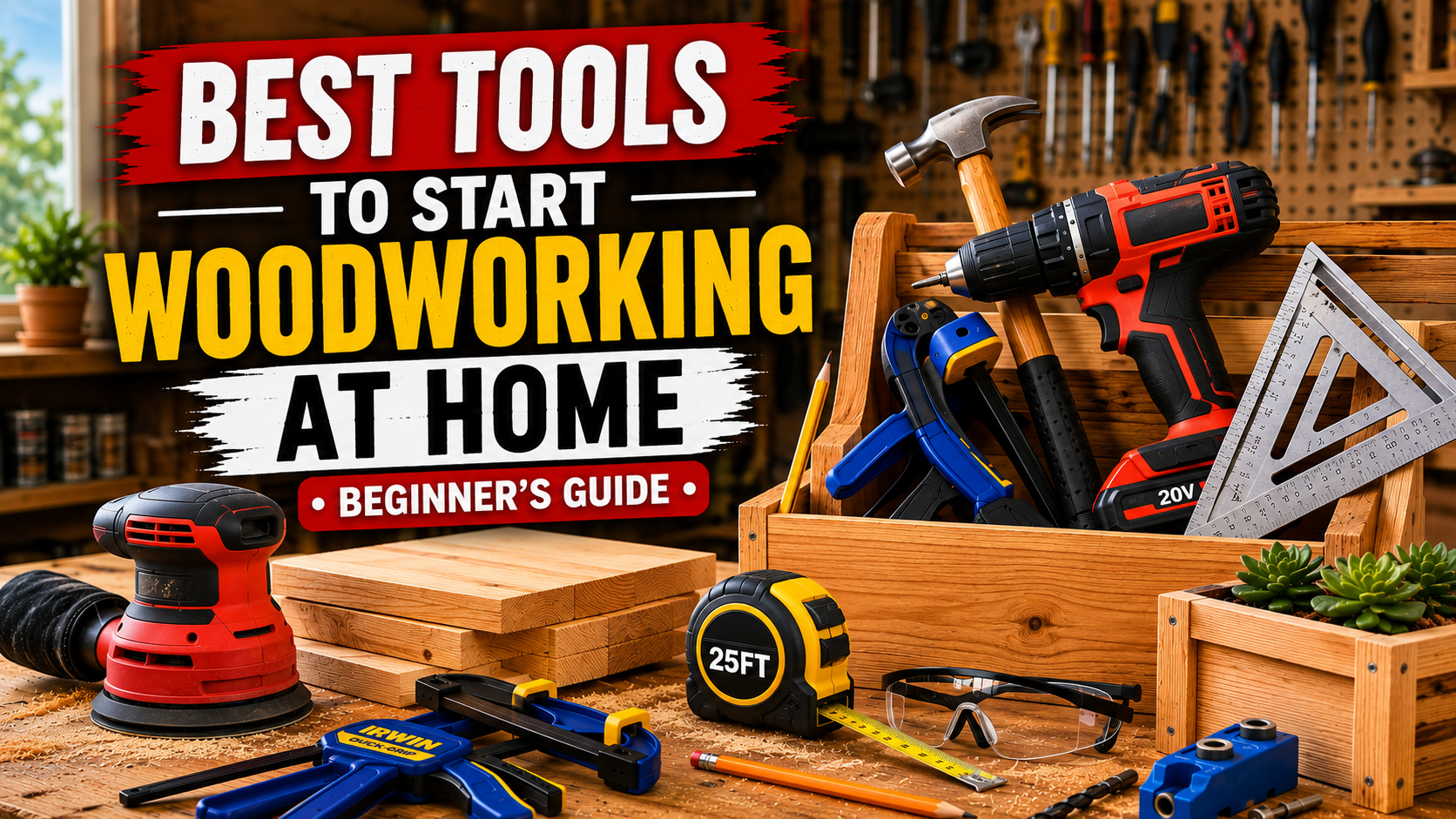
Best Tools to Start Woodworking at Home: Beginner’s Guide
Want to start woodworking but don’t know which tools you actually need? You do not need a $10,000 workshop to build your first shelf, table, planter, bench or home décor project.
A small collection of dependable tools can handle a surprising number of beginner woodworking projects.
One of the biggest mistakes new woodworkers make is buying too many specialized tools before they know what they enjoy building.
A better approach is simple: buy the tools that solve the most problems first. Learn how to measure accurately, make clean cuts, drill straight holes, clamp your work securely and create a smooth finish. Then expand your workshop as your skills and projects grow.
Quick Picks: The 5 Tools I’d Buy First
- Measuring tape and speed square — accurate measuring and marking
- Cordless drill/driver — drilling and assembling projects
- Circular saw or jigsaw — cutting lumber and sheet goods
- Clamps — holding projects securely during assembly
- Random orbital sander — producing a smooth finished surface
Starting on a tight budget? Buy these five categories first. A workbench, pocket-hole jig and miter saw can come later.
Beginner Woodworking Tool Checklist
| Tool | Best For | Priority |
|---|---|---|
| Measuring Tape + Speed Square | Measuring and marking | Essential |
| Cordless Drill | Drilling and assembly | Essential |
| Circular Saw/Jigsaw | Cutting lumber | Essential |
| Clamps | Assembly and glue-ups | Essential |
| Random Orbital Sander | Finishing | Essential |
| Portable Workbench | Stable workspace | Upgrade |
| Pocket-Hole Jig | Furniture joinery | Upgrade |
| Miter Saw | Fast repeatable cuts | Upgrade |
5 Essential Tools to Start Woodworking at Home
1. Measuring Tape & Speed Square

There is an old woodworking rule worth remembering: measure twice, cut once.
Your project can only be as accurate as your measurements. A measuring tape handles dimensions while a speed square makes it much easier to mark straight 90-degree lines, check corners and mark common angles.
For a beginner shop, a 25-foot measuring tape is more than enough for most furniture and DIY projects.
- Measure boards before cutting
- Mark straight 90° lines
- Mark 45° angles
- Check whether assemblies are square
- Reduce wasted lumber caused by bad measurements
2. Cordless Drill / Driver

If I could recommend only one power tool to a new woodworker, a cordless drill/driver would be near the top of the list.
You’ll use it for drilling pilot holes, driving screws, installing hardware and assembling projects. Unlike more specialized tools, a drill earns its place in the shop almost immediately.
Look for a kit that includes a battery and charger. If you plan to buy more cordless tools later, consider the battery platform before choosing a brand because compatible batteries can save money as your collection grows.
- Variable-speed trigger
- Comfortable grip
- Rechargeable battery
- Battery charger included
- Common drill and driver bits available
3. Circular Saw or Jigsaw

You need a way to cut wood, but that does not mean your first purchase has to be an expensive table saw.
A circular saw is generally the better choice for long, straight cuts. Pair it with a straightedge guide and it can handle a large amount of beginner woodworking.
A jigsaw is useful when you need curved cuts, cutouts or more maneuverability.
| Choose | If You Need |
|---|---|
| Circular Saw | Long, straight cuts in boards and plywood |
| Jigsaw | Curves, shapes and smaller controlled cuts |
4. Woodworking Clamps

Clamps are the extra pair of hands every woodworker eventually learns to appreciate.
They hold pieces together while glue cures, keep boards from shifting during assembly and help secure material while you’re working.
A simple starter collection could include two smaller quick-grip clamps and two longer bar clamps. Add more sizes when your projects require them.
5. Random Orbital Sander

You can build a structurally sound project and still make it look unfinished by rushing the sanding stage.
A random orbital sander speeds up surface preparation and helps remove scratches and rough spots before you apply paint, stain or another finish.
A common beginner progression is to start with a coarser grit when necessary and gradually move toward finer sandpaper rather than trying to make one grit do everything.
3 Tools Worth Buying After the Basics
Once you’re actually building projects, you’ll discover where your starter setup slows you down. That’s the right time to upgrade.
6. Portable Workbench

A sturdy work surface makes measuring, cutting, clamping and assembly easier. A folding workbench is especially useful if you’re woodworking in a garage that still needs to function as a garage.
7. Pocket-Hole Jig

If your projects are moving toward tables, cabinets, shelves and other furniture, a pocket-hole jig can make joinery much easier for a beginner.
It allows screws to enter the workpiece at an angle, producing useful joints while keeping much of the fastening hardware hidden.
8. Miter Saw

A miter saw becomes valuable when you repeatedly cut boards to length or need consistent angled cuts.
It’s particularly useful for furniture components, trim, frames and projects that require multiple pieces cut to identical dimensions.
Don’t Forget Woodworking Safety Gear
Safety equipment isn’t the exciting part of building a workshop, but it belongs on the shopping list from day one. At minimum, consider proper eye protection, hearing protection and suitable respiratory protection when producing wood dust.
How Much Should a Beginner Spend on Woodworking Tools?
There isn’t one magic number. Your budget should depend on what you’re actually planning to build.
If you’re just testing the hobby, start with measuring tools, a drill, clamps and whichever cutting tool your first project requires. You can also use hand sanding initially if necessary.
The important part is to avoid buying an entire workshop before completing your first project. Let your projects tell you which tool to buy next.
Corded vs. Cordless Woodworking Tools
Cordless tools are convenient in garages, sheds and small workshops because there are fewer cords to manage. Corded tools can still make excellent sense for stationary or high-use equipment where mobility isn’t important.
If you choose cordless, think about the battery ecosystem—not just the individual tool. Staying within one compatible battery platform can simplify your workshop and reduce the number of chargers and batteries you need.
What Should a Beginner Build First?
Your first project should be simple enough to finish but useful enough to make the effort worthwhile.
Good beginner projects include a basic shelf, planter box, small bench, simple side table, storage crate or basic garage organizer.
The objective isn’t to create a masterpiece on day one. It’s to practice the core sequence:
Measure → Mark → Cut → Assemble → Sand → Finish.
Have the Tools? Now You Need a Project.
Buying tools is the easy part. Knowing exactly what to build—and how to build it—is where beginners often get stuck.
If you’d rather follow step-by-step project plans instead of figuring everything out from scratch, you can check out this collection of woodworking plans.
Frequently Asked Questions
What tools should a beginner woodworker buy first?
Start with measuring and marking tools, a cordless drill, a suitable saw, clamps and sanding equipment. These categories cover the basic tasks involved in many beginner projects.
Do I need a table saw to start woodworking?
No. Many beginner projects can be completed with a circular saw or jigsaw. A table saw may become useful later, but it doesn’t have to be your first major purchase.
Can I start woodworking in my garage?
Yes. A garage can work well for a small woodworking setup, provided you have adequate workspace, lighting, ventilation, dust control and safe tool operation.
Should beginners buy cordless or corded tools?
Both have advantages. Cordless tools provide portability and convenience, while corded tools can be practical when a tool stays in one location and continuous power is more important than mobility.
What’s the most important woodworking tool?
There isn’t one tool that replaces everything else, but accurate measuring tools and a dependable drill/driver are among the most universally useful purchases for a beginner.
Final Thoughts: Start Small and Build Your Workshop Over Time
The best woodworking shop isn’t the one with the most tools. It’s the one where the tools actually get used.
Start with the essentials. Build a real project. Learn what slows you down. Then buy the next tool because you need it—not because somebody convinced you that a woodworker must own everything.
That’s how workshops have traditionally grown, and it’s still one of the smartest ways to start woodworking at home today.
Ready for Your First Woodworking Project?
Pick a project, gather your tools and start building. If you want a larger collection of project ideas and step-by-step plans, take a look below.
Leave a Reply